Da Nang International Airport, one of the most important gateways in Vietnam’s central region, went through the Lunar New Year of Bính Ngọ 2026 under red alert conditions.
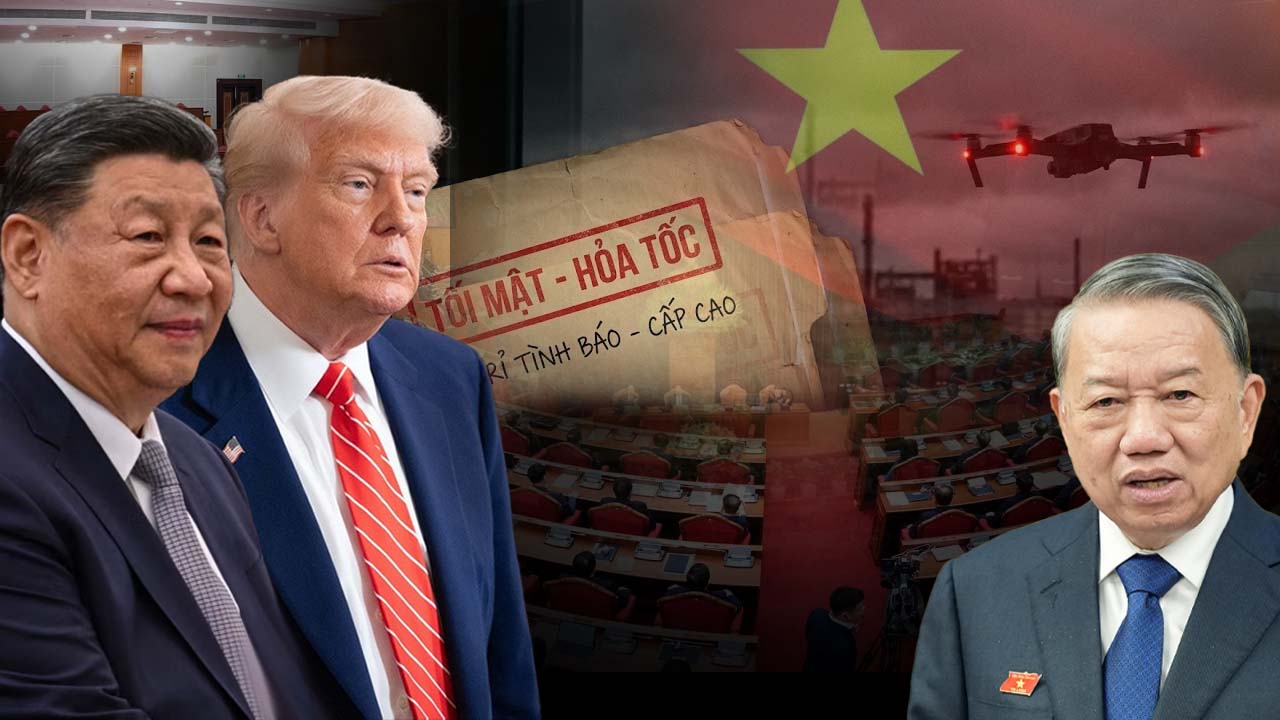
A series of unmanned aerial vehicles (drones) repeatedly intruding into restricted airspace during the Lunar New Year holiday caused dozens of flights to be paralyzed, forcing air defense and security forces to respond on an “emergency” basis.
Notably, the incident occurred just as General Secretary Tô Lâm had concluded his visit to the United States. This carried the smell of “gunpowder” — an implicit retaliatory message from a “strange country” aimed at Hanoi.
The use of drones is a typical tactic in “gray zone” warfare, which some countries employ to exert pressure without formally declaring war. In the context of Vietnam’s efforts to free itself from the tariff “pressure” of Donald Trump’s administration, the paralysis of Da Nang Airport was a harsh “warning” from the North.
This suggests that while Mr. Tô Lâm was “forgetting Tet” in order to go to the U.S., back in Ba Đình, rival forces within the Party were already prepared to use “maneuvers” to test his nerves.
Vietnam’s predicament became even more serious when a “Top Secret – Urgent” report from the Vietnamese Embassy in the United States, dated February 22, 2026, suddenly appeared on social media after being leaked.
Thoibao.de cannot confirm the authenticity of this document, but the “report” exposed one danger: Vietnam risks being reduced to a “secondary” factor in a bargain of interests between the two superpowers, the United States and China.
According to the document, the White House’s announcement that President Donald Trump would visit Beijing at the end of March 2026 for talks with President Xi Jinping had already created an unfavorable “shockwave” in high-level strategic forecasts.
Hanoi’s leadership had quickly realized that the United States regards Vietnam as an important partner, but not yet an “irreplaceable” one, and that Washington could fully accept a certain degree of compromise with China in exchange for stability.
When the report from Vietnam’s embassy in Washington pointed out a “narrow gap” of strategic opportunity, it also stressed that if this were allowed to happen, all of Mr. Tô Lâm’s efforts to upgrade relations with the United States would become meaningless.
At the same time, it reportedly recommended that the Politburo proactively propose an “urgent” high-level meeting between Mr. Tô Lâm and Mr. Trump in Washington before March 31, 2026.
Hanoi’s intention is very clear: both the United States and China must be forced to regard Vietnam as a fixed strategic factor that cannot be ignored in any geopolitical arrangement in the region.
However, the question is how Vietnam will respond when every move toward closer ties with the U.S. is immediately met by Beijing with “covert” actions such as the drone incident in Da Nang.
Vietnam’s “balancing” foreign policy is now approaching the limits of what the major powers are willing to tolerate. Beijing views Vietnam’s upgrading of security ties with the U.S. as an ideological betrayal and a direct threat to its core interests.
According to analysts, Mr. Tô Lâm now faces the biggest political gamble since consolidating absolute power after the 14th Party Congress. On the one hand, he must demonstrate toughness in order to protect his authority against acts of collusion with foreign forces from within the Party.
In short, the drone incident in Da Nang and the leaked confidential report from Washington are signs that General Secretary Tô Lâm’s “new era” will not be a path paved with the roses of diplomacy.
If Mr. Tô Lâm cannot prove that he is truly “irreplaceable” through both real capability and political resolve, then total victory at the 14th Party Congress will not be enough to guarantee a secure position for the man at the top.
Tra My – Thoibao.de